
"The trend is your friend" is classic advice for one simple reason: trading with the trend means working with the market's dominant pressure, not against it. This chapter ties the previous lessons together into one way of looking at the market.
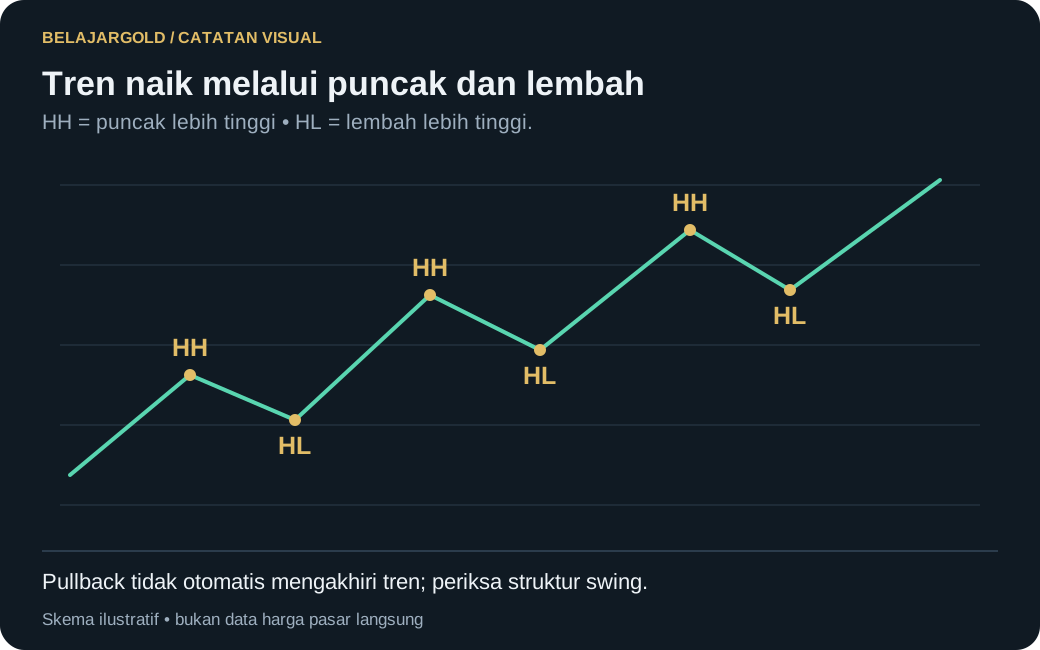
Recognizing a trend from structure
- Uptrend: a series of higher highs and higher lows. Buyers are in control.
- Downtrend: a series of lower highs and lower lows. Sellers are in control.
- Sideways / ranging: highs and lows are level. Neither side is winning — it is often better to wait.
Tools: trendlines and moving averages
A trendline is drawn connecting at least two lows (in an uptrend) or two highs (in a downtrend). Its purpose is to visualize the slope and provide a reaction area.
A moving average (for example, the 50 MA and 200 MA) is used as a direction filter: if price stays consistently above a rising MA, the bias is up; if it stays below a falling MA, the bias is down. An MA is not a standalone entry signal — it is context.
The "follow the trend" principle in practice
- Identify the trend on a higher timeframe (H4/D1). This sets the direction you are allowed to trade.
- Wait for price to pull back to an interesting area: a trendline, an MA, or a support/resistance level that has flipped roles.
- Look for a trigger in the direction of the trend on a lower timeframe (a continuation candle pattern, a minor breakout).
- Place your stop loss on the side that proves your scenario wrong — usually beyond the last swing point.
- Let the target follow the structure: the next high/low, or trail behind higher lows / lower highs.
Common mistakes when trading against the trend
- Guessing tops/bottoms. "It has gone up a lot, so it must fall" is not analysis — it is an opinion. Trends can last far longer than expected.
- Adding to losing positions (averaging down) against the direction. This increases risk precisely when the market is telling you that you are wrong.
- Treating sideways as a trend. Trend-following strategies perform poorly in flat markets; identify the condition first.
When "follow the trend" is less suitable
When the market is in a wide range, or ahead of high-impact news releases that can reverse direction instantly. In those conditions, reducing position size or not entering at all is a legitimate decision.
Key points
- Trend = the side that is currently in control. Trade on its side.
- The best entries usually come on a pullback within the trend, not after price has already run far.
- Trendlines and MAs are directional context, not buy/sell buttons.
- Trading against the trend requires very strong reasons and much smaller risk.
Risk disclaimer: all content on this site is provided for educational purposes and is not financial advice, signals, an invitation to trade, or a promise of profit. Trading carries a high risk and may result in the loss of part or all of your capital. Check the legality of service providers in your jurisdiction.